Green Growth in Action: How India Built a Sustainable, Climate-Resilient Future
A Twelve-Year Odyssey of Ecological Restoration, Adaptive Governance, and Global Leadership
The Architecture of Transformation
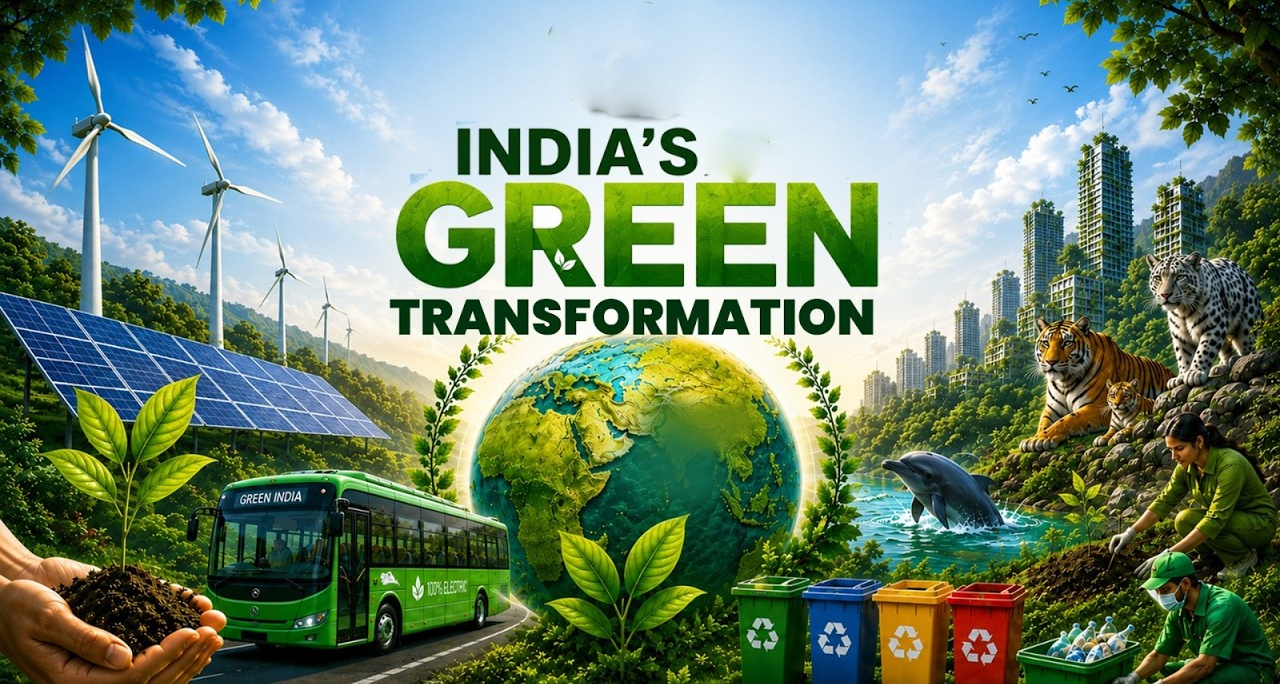
Over the past twelve years, India has executed a sustained environmental transformation through deliberate policy action, institutional reform, and systematic implementation. Grounded in the principles of Vishwaas (Trust), Nirman (Development), and Jan Kalyaan (Public Welfare), the nation’s strategy recognizes ecological security not as an obstacle to economic growth, but as its primary foundation.
Faced with intensifying global resource pressures and climate vulnerability, India has balanced development with conservation, giving rise to Three Pillars of Green Transformation:
Pillar 1: Increasing Ecological Capability and Biodiversity
Pillar 2: Expanding National Capacity and Circular Systems
Pillar 3: Enhancing Global Credibility and Climate Leadership
Together, these pillars mark a structural shift toward resilient ecosystems, technology-driven environmental governance, and an influential voice in global climate architecture.
Pillar 1: Increasing Ecological Capability and Biodiversity
Healthy natural systems provide the baseline for national resilience against environmental shocks. Through large-scale habitat restoration, species protection, and river rejuvenation, India has significantly broadened its ecological capacity.
Reviving Forest Landscapes
Forests serve as vital carbon sinks, regulate hydrological cycles, and sustain millions of livelihoods. The Green India Mission (GIM), launched in FY 2015–16 under the Ministry of Environment, Forest and Climate Change, serves as the core vector for forest restoration. As of March 2026, ₹1,019.26 crore has been deployed across states to enhance forest quality and carbon capture.
National Forest Cover: According to the India State of Forest Report (ISFR) 2023, combined forest and tree cover spans 8.27 lakh sq. km (25.17% of the total geographical area).
Forest Cover: 7.15 lakh sq. km (21.76%)
Tree Cover: 1.12 lakh sq. km (3.41%)
Carbon Stock: 30.43 billion tonnes
| Category | Area (lakh sq. km) | Share of Total Area |
|---|---|---|
| Forest Cover | 7.15 | 21.76% |
| Tree Cover | 1.12 | 3.41% |
| Total Green Cover | 8.27 | 25.17% |
Targeted Landscape & Urban Forestry Programs
CAMPA Initiatives: Under the Compensatory Afforestation Fund Act, 2016, over 3.20 lakh hectares were planted between FY 2020–21 and 2024–25. Governance is digitized via GIS monitoring, Digital Annual Plans, and the HARIT-SANKALP platform.
Nagar Van Yojana (NVY): Designed to establish 1,000 urban forests by FY 2026–27. By March 31, 2026, the National Authority had released ₹557.62 crore for 626 Nagar Vans/Vatikas.
Aravalli Green Wall Initiative: Targeting 6.31 million hectares of degraded land across Rajasthan, Gujarat, Haryana, and Delhi. Supported by 435 nurseries holding 393.24 lakh seedlings, it restored 36,025 hectares in 2025 alone.
Restoring River Ecosystems
Water pollution degrades aquatic food chains and impairs natural self-cleansing processes. Launched in June 2014, the Namami Gange Programme addresses these issues across the Ganga basin through sewage treatment infrastructure, industrial effluent monitoring, riverfront development, and community engagement. Supported by an initial outlay of ₹20,000 crore and extended under Phase-II through March 2026 with an additional ₹22,500 crore, the program has drastically reduced pollution levels and revitalized riverine biodiversity.
A Model of Policy and Delivery Alignment
By meeting key climate commitments years ahead of schedule and launching global platforms like the International Solar Alliance (ISA), Coalition for Disaster Resilient Infrastructure (CDRI), Mission LiFE, and the International Big Cat Alliance (IBCA), India has proven that ambitious policy design can directly yield measurable ecological results. Through balanced investment in natural capital and institutional readiness, the nation continues to strengthen its domestic resilience while serving as a reliable benchmark for sustainable development.